Showing posts with label Book. Show all posts

Thursday, October 27, 2011

A Book About Innocent


"A Book About Innocent: Our Story and Some
Things We've Learned"
image from http://www.amazon.com/
I bought this book a month ago and have not started reading it since this week. Now that I've started it, I cannot understand why I did not start it earlier. I've you haven't read it, I strongly recommend it.

"A Book About Innocent: Our Story and Some Things We've Learned" by Dan Germain, Richard Reed and John Hamilton, has a pretty self-explanatory title. I'm only half-way through but I've been amazed by how such a great business, that has been used many times as a case example, really started. With no resources, strong will and a simple idea they were able to build in 10 years a £100 million company with 250 people. They want to create a business they can be proud of. And they want innocent to become a global, natural, ethical food and drinks company, always remaining commercially successful and socially aware.

The book itself clearly is an example of what Innocent stands for: Be Natural, Be Entrepreneurial, Be Responsible, Be Commercial and Be Generous.
The book is printed on 100% recicled paper with vegetable-based inks. They are simple and direct.

There's a story that really caught my attention, it was how the 3 friends decided to leave their jobs and start the adventure. Let me tell you about it.

To make the story short, the 3 friends had good paying jobs and were working in great companies, but since college they had joked about starting a business together. After they came up with the natural smoothie idea at the age of 26, they started working on the innocent project on their free time. They developed recipes and found a small farmer who would produce and bottle their products. They decided to run a test, they bought £500 of fruit to produce a batch and sell it at a London music festival they were organizing, to actually see if people liked them and if they would be willing to buy them.

How to measure the results? First they wanted to hand out a two page survey to see what people thought about it but realised it was simply to much. The wanted to know a simple thing, if they liked the products. With some help they developed a new simple testing method. They put up a sign with the question "Do you think we should give up our jobs to make these smoothies?" and put out two bins, one saying "YES" and the other saying "NO", and asked people to put their empty bottle in the right bin. At the end of the weekend the "YES" bin was full, so they went in the next day and resigned.

This is how the Bins Test was born.

It may not be the most orthodox way to conduct research, but it did meet their purpose. In addition, considering the limited market test budget (which was none) I think the idea was brilliant. This is a clear example that necessity is the mother of invention. (Or as it would be said in Spanish "La necesidad agudiza el ingenio").

Have any of you read the book or have other examples of great ideas pursued with few resources? Would love to hear of them.

Sunday, January 9, 2011

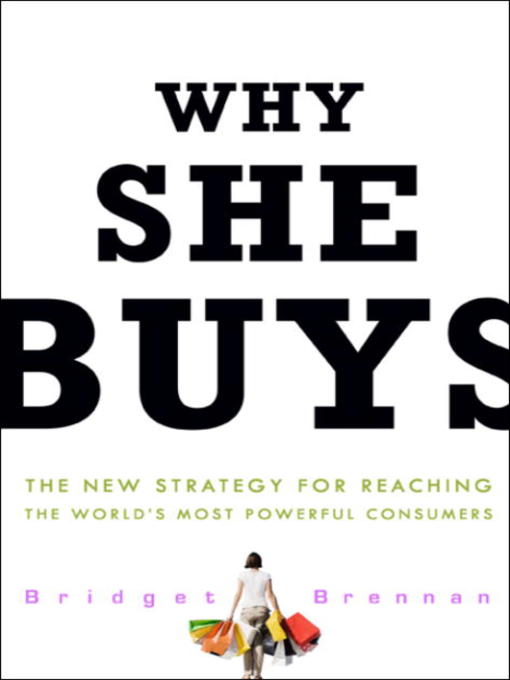
Why She Buys - Must read book


The more I read this book, the more I have the urgency to share it. Why should you read this book:
·       Women drive consumer purchasing.
·       Men dominate the senior levels of most companies that make and market the products women buy.
·       Men and women are so different, they often have trouble communicating with one another.
·       Understanding these differences can provide businesses with significant competitive advantage, but it takes work.
·       The gender gap is a source of missed opportunities and lost revenue, and it should be addressed through education and training.
·       Political correctness stifles frank discussion of the subject, even among women.
·       Much of the biological research on the brain differences between genders is relatively new and hasn’t trickled down to either the general public or the business world.
·       Gender differences are not widely taught in business courses at the undergraduate level or in MBA programs.
·       The fish are the last to discover the ocean.
·       Women dominate the consumer economy thanks to the combination of purchasing power and influence.
>> Chapter 1 Excerpt
At school, nobody ever mentioned differences between men and women. After 5 years, not even one mention to this subject was made. I have studied differences between cultures: how to make business in China, in Middle East, in Japan, in the United States,... but never differences between genders. We are all considered the same – but the truth is we are in fact very different. We talk differently, we relate differently, we view the world differently, we are interested by different things, and respond differently to the same situations... so when targeting products to women – the main buyers of all consumer goods – we should be more aware of all these differences and drivers.
While reading this book I realise that one of the most useful subjects we could, and should, study in business schools is gender differences. We would be able to better understand men and women and their behaviours in all aspects of life – and more specifically understand better their shopping habits and drivers.
Until that day, read this book and you'll understand what I mean.

Thursday, January 6, 2011

Why She Buys - Bridget Brennan


Unlike men, women feel the sense of urgency, even obligation, to tell people about a new product or service they’ve discovered.
I just read this sentence and I must say I feel it is true. As a woman I feel I must share with you this new discovery that came as a gift under the Christmas tree, a book that I truly believe to be necessary and useful: “Why She Buys – The new strategy for reaching the world’s most powerful consumers” by Bridget Brennan. 
It’s an amazing book that should be a must read for everyone who works in marketing, sales or owns a business. It helps understand in a highly informative and etertaining way women’s beliefs, values and sensitivities, and since they account for 80 percent of consumer spending in the US (and the world) alone it’s a great way to get a wide insight of your main costumer’s: women.
I wanted to introduce you to it and share some quotes and ideas that might interest you – but I strongly recommend you to read it. It will help you understand in depth through many stories and examples how and why women are as they are and, subsequently, why they buy.
Here you have Bridget Brennan introducing her book:
This book is designed to teach you what business schools don’t – how to craft your products, pitches, and marketing campaigns to cater to female buyers. Women are females first and consumers second. The ability to understand their brain structures, priorities, worldviews, and demographic patterns can provide your company with one of the most genuine competitive advantages it may ever know. And the bonus of reaching female buyers is that when it’s done well, you’ll make your male customers happier too, and they won’t even realice they weren’t your original targets.
                        >> Women are female first and consumers second – Page 5
You’ll be very happy you picked this book up and will want to share your discovery with everyone else.

Tuesday, December 7, 2010

Kotler on Marketing

For those of you who may not know him, Philip Kotler (born 27 May 1931 in Chicago) is considered by many the father of modern marketing. He is s the S.C. Johnson & Son Distinguished Professor of International Marketing at the Kellogg School of Management at the Northwestern University.

Professor Kotler's book, Marketing Management, is the world's most widely used graduate level textbook in marketing. He has written many articles, textbooks and books such as Marketing: An Introduction and Principles of Marketing , all of them widely used in the world.I would recommend you to go through some of them - they are great reference books.

Here are some quotes from his book Kotler on Marketing that I hope you will enjoy and will make you think:

> There are three kinds of companies: those who make things happen, those who watching things happen, and those who wonder what’s happened.    -- Anonymous

> There are two kinds of companies: those who change and those who disappear.

> Marketing has the main responsibility for achieving profitable revenue growth for the company.

> Quality is when our customers come back and our products don’t.

> Marketing must identify, evaluate, and select market opportunities and lay down strategies for achieving eminence if not dominance in target markets.

> Marketing is far too important to be left only to the marketing department.

> Companies can’t give job security. Only customers can!